
Chapter 1 — The Empty Field
July 2026
The Lives We Never Lived: A novel inspired by the four pillars of the ALMA Method.
Over the next twelve months, we will publish a novel inspired by the four pillars of the ALMA Method: Awareness, Liberation, Manifestation, and Alignment.
Each week, we will share a new chapter in the story of Adrián, a man who abandoned his pregnant partner and who, seventeen years later, is forced to face the consequences of his decisions.
Through memories, conversations, wounds, and second chances, Adrián will begin a journey of awareness, liberation, transformation, and coherence that will lead him to search for the daughter he never knew.
But this is not only a story about recovering lost time.
It is a novel about responsibility, forgiveness, boundaries, and the possibility of becoming someone different, even when no one can guarantee that we will be forgiven.
Welcome to The Lives We Never Lived.
• By ALINÉA
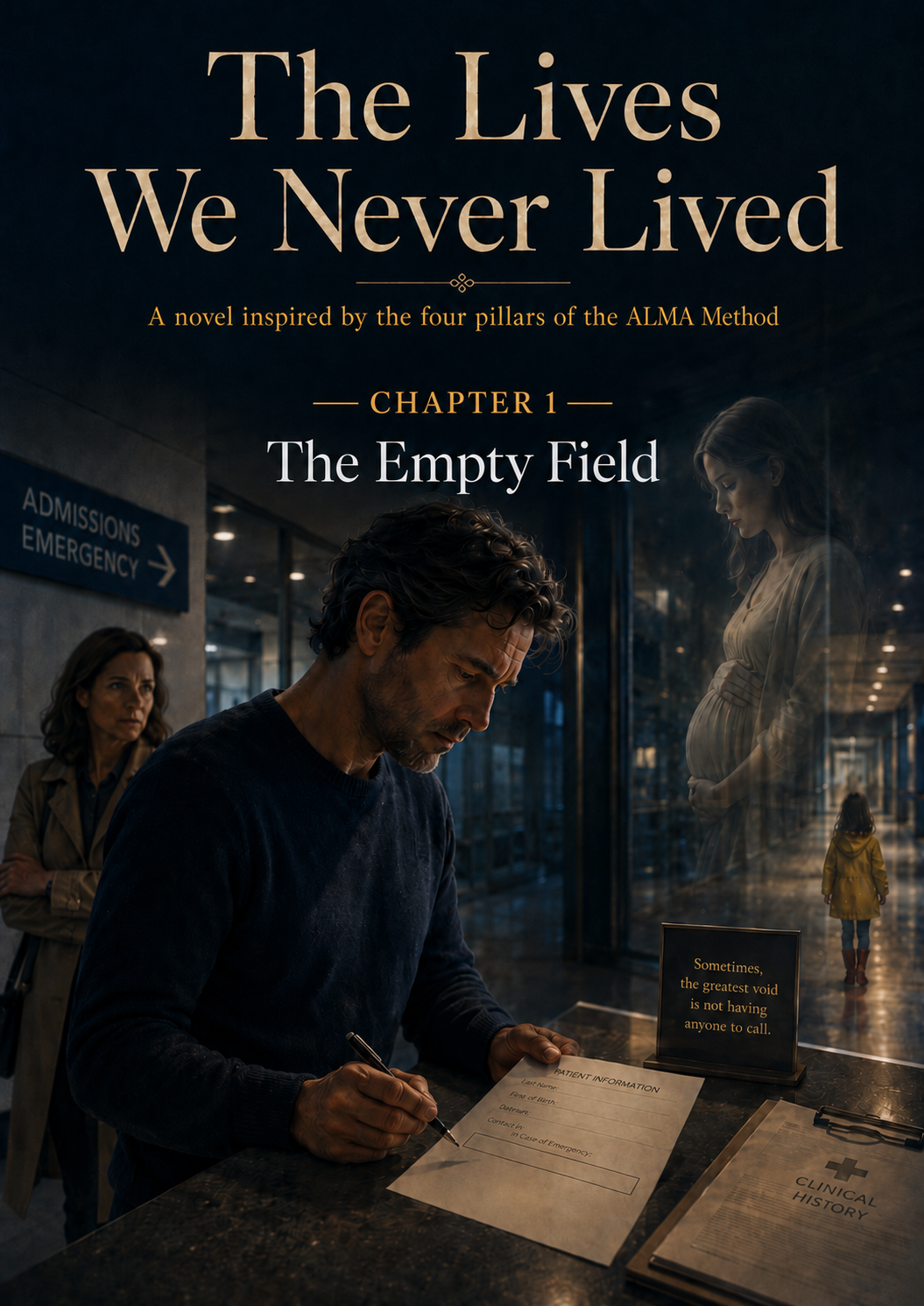
Chapter One: The Empty Field
Adrián felt the first pain just below his sternum.

It was brief—a dull pressure that disappeared before he could decide whether it was worth worrying about.

He kept talking.

"What matters isn't selling them a campaign," he said, gesturing towards the screen. "What matters is making them believe the campaign is about them."

Seven people sat around the table, watching him in silence. Some nodded. Others leafed through the presentation in front of them. On the wall behind him, a slide showed a smiling family walking into a bright new home.

Adrián knew this moment well.

The moment when people stopped listening to the words and started believing the person speaking them.

He'd always been good at that.

He knew exactly when to lower his voice, when to pause, and when to hold the gaze of the one person in the room who still wasn't convinced.

"People don't buy a house," he continued. "They buy the life they imagine living inside it."

The pain came again.

Sharper this time.

He set the presentation remote on the table and rested one hand on the back of a chair.

Lucía, sitting near the door, watched him closely.

"Are you all right?"

"Perfectly."

He smiled, but something had shifted.

Air filled his lungs, yet somehow it never seemed to reach the bottom. He drew another breath. Then another. The harder he tried to breathe, the tighter his chest became.

One of the clients looked up.

"Would you like to take a short break?"

"No, let's keep going."

Adrián tried to continue, but the words came out in the wrong order. The screen grew painfully bright. The room seemed to drift several metres away, while every voice echoed unnervingly close.

A tingling sensation spread through his fingers.

Then his lips.

"Adrián," Lucía said, pushing back her chair. "Sit down."

"I'm fine."

"I'm telling you to sit down."

He looked at her, irritated. He searched for one of the quick jokes he normally used to regain control of a room.

Nothing came.

His heart hammered against his ribs.

For one terrifying moment, he knew he was going to die.

It wasn't a thought.

It was certainty.

The meeting. The clients. The presentation. The folders scattered across the table.

None of it mattered anymore.

He pressed a hand against his chest.

"I can't breathe."

Lucía reached him just before his legs gave way.

"Look at me."

"Call an ambulance."

"They already have."

"Something's happening to me."

"Adrián. Look at me."

"I can't breathe."

"Yes, you can. You're breathing."

"I can't get enough air."

She cupped his face in both hands.

"Don't try to fill your lungs. Just let the air out."

"What?"

"Slowly. Breathe out."

He did as she said.

"Again," she whispered. "Don't breathe in yet. Empty your lungs first."

His body no longer felt like his own. His hands shook. Sweat soaked through the back of his shirt. A heavy pressure spread down his left arm.

"It's my heart."

"We don't know that."

"It's my heart, damn it."

"The ambulance is on its way."

One of the clients had opened the meeting room door. The others remained frozen, caught somewhere between concern and awkwardness.

Adrián closed his eyes.

An image flashed across his mind.

A little girl stepped through a puddle in bright red wellington boots. She wore a yellow raincoat, her hair tied back in a hurried ponytail. Across the street, a woman called after her, telling her to wait.

The image lasted no more than a second.

His eyes snapped open.

"What is it?" Lucía asked.

"Nothing."

"Is the pain getting worse?"

"No."

The girl was gone.

So was the woman.

He had no idea who they were.

The ambulance doors slammed shut behind him.

One paramedic attached electrodes to his chest while the other began asking questions.

"Full name?"

"Adrián Vidal Romero."

"Age?"

"Forty-three."

"Are you taking any medication?"

"No."

"Any history of heart problems?"

"Not that I'm aware of."

"Have you taken any drugs or other substances today?"

Adrián looked at him.

"Coffee."

"Anything else?"

"Two coffees."

"I'm asking about recreational drugs."

"No."

The paramedic made a note without reacting to his tone.

"Has anything like this ever happened before?"

"Never."

"Have you been under a lot of stress recently?"

"The usual amount."

The paramedic looked up.

"And what does the usual amount look like?"

"Work. Meetings. Clients who don't know what they want and expect you to figure it out for them."

"That doesn't sound particularly healthy."

"It depends what you do for a living."

Lucía sat opposite him, his bag resting on her lap. She hadn't taken her eyes off him.

"He hasn't been sleeping properly for weeks," she said.

Adrián turned towards her.

"I haven't been sleeping badly for weeks."

She raised an eyebrow.

"You emailed me at four o'clock yesterday morning."

"Because I was awake."

"That's exactly what sleeping badly means."

"You don't need to narrate my entire life."

"Someone has to," she replied. "You're determined to pretend nothing's wrong."

The paramedic smiled to himself.

"Your heart rate's coming down," he said. "Just keep breathing normally."

"I've been breathing normally my whole life."

Lucía shook her head.

"I'm not entirely convinced."

He wanted to answer, but exhaustion settled over him instead.

He leaned his head against the wall of the ambulance and closed his eyes.

The girl in the yellow raincoat appeared again.

This time she wasn't walking.

She stood perfectly still, her back to him, staring at something he couldn't see.

He opened his eyes before she could turn around.

The tests showed no sign of a heart problem.

Adrián listened to the doctor's explanation from a hospital bed, still wearing his suit trousers beneath a gown that refused to stay closed. The doctor held a tablet in one hand and spoke with the calm assurance of someone who had delivered the same news countless times.

"Your ECG is normal. So are your blood tests. There's no evidence you've suffered a cardiac event."

"Then what happened?"

"Based on your symptoms, and after ruling out other possible causes, the most likely explanation is that you experienced a panic attack."

Adrián gave a short, humourless laugh.

"I don't have anxiety."

The doctor's expression remained unchanged.

"You had a panic attack."

"But I'm not an anxious person."

"Anxiety isn't concerned with the kind of person you think you are."

Adrián looked away.

Beyond the curtain, someone was coughing relentlessly. A trolley rattled along the corridor, one wheel squeaking every few seconds.

"It's been a difficult week," he said at last. "I was probably just exhausted."

"That may have contributed."

"I haven't been sleeping much."

"That may have contributed too."

"So that's what caused it."

The doctor set the tablet on a nearby table.

"Adrián, I can give you an explanation that lets you leave here feeling reassured, or I can tell you something you may find harder to hear."

"Tell me the truth."

"Your body reacted as though you were in immediate danger, even though no danger was present. That doesn't mean you're weak, and it certainly doesn't mean you're losing your mind. But it would be worth asking yourself what you've been carrying for so long that your body felt the need to sound the alarm."

"I'm not carrying anything."

The doctor held his gaze for a few quiet seconds.

"All right."

Something about those two words irritated Adrián far more than an argument would have.

"What does that mean?"

"It means I can't make you look at something you're not ready to see."

"I came here because of chest pain, not to have my life analysed."

"You came here because you believed you were dying."

The words settled between them.

Adrián lowered his eyes to his hands.

They had finally stopped shaking.

"We're going to discharge you," the doctor said, breaking the silence. "Go home and get some rest tonight. Avoid alcohol, cut back on the coffee, and if the symptoms return, come straight back to A&E. I'd also recommend making an appointment with your GP and considering some professional support."

"I don't need a psychologist."

"Perhaps you don't."

The doctor picked up his tablet.

"But needing help and being willing to accept it are two different things."

He turned to leave, then paused.

"Do you live alone?"

"Yes."

"Is there anyone who can stay with you tonight?"

Adrián hesitated a fraction too long.

"I'll be fine."

"I didn't ask whether you'd be fine," the doctor said evenly. "I asked whether there was anyone."

Adrián looked away.

"No."

The doctor gave a small nod.

"Then keep your phone close."

The curtain swayed gently as he left.

Lucía was waiting in the corridor, holding two plastic cups.

"I brought you some water."

"Thanks."

"I cancelled this afternoon's meeting."

Adrián looked at her.

"Why?"

She stared at him in disbelief.

"Because two hours ago you thought you were having a heart attack."

"But I wasn't."

"Oh, well, in that case, perhaps you'd like to go back and finish the presentation."

"Don't be dramatic."

She handed him the cup.

"You asked someone to call an ambulance in front of eight people."

"Seven."

"What?"

"There were seven."

She looked at him for a long moment, torn between laughing and losing her patience.

"You're impossible."

"So I've been told."

"Do you want me to take you home?"

"I can get a taxi."

"I didn't ask whether you could."

He took a sip of water.

"Why has everyone suddenly started interrogating me today?"

"Because every answer you give avoids the question you were actually asked."

He couldn't argue with that.

Instead, he drank a little more water and followed her towards the admissions desk.

Before they left the hospital, a woman behind a glass partition handed him a clipboard.

"I just need you to check your details and sign at the bottom."

Adrián scanned the form.

Name.

Address.

ID number.

Telephone.

Everything was correct.

Then his eyes stopped on an empty box.

Emergency Contact

Below it were two blank lines.

Name

Telephone

"You haven't filled this section in," the administrator said.

Adrián held the pen above the paper without writing.

"You can leave it blank."

"We strongly recommend providing someone's details."

He glanced at Lucía.

She quietly looked away, as though she didn't want him to mistake her presence for an invitation.

He thought of Samuel.

He realised he couldn't remember his phone number. They'd communicated only through messages for years, and Samuel rarely replied before midday.

Then he thought of his sister, Clara.

They hadn't spoken in nine months. The last conversation had ended with her telling him he only ever called when he needed something.

Then Irene.

She'd moved out two months earlier, taking the last of her belongings with her.

Before she left, she'd asked him not to contact her again.

"Sir?"

The administrator's voice brought him back.

"You can leave it blank."

"We could add the colleague who came with you."

"She's a colleague."

Lucía glanced at him.

She didn't look offended.

For some reason, that made him feel even worse.

The administrator took back the paperwork, but Adrián still hadn't let go of the pen.

His eyes lingered on the empty box.

For years he'd convinced himself that being alone was freedom.

He could travel whenever he wanted. Move city without consulting anyone. Work until three in the morning. Disappear for days and return as though nothing had happened.

He'd mistaken independence for invulnerability.

But standing beneath the harsh white lights of the hospital, loneliness no longer looked like freedom.

It looked like a blank space where a name should have been.

"Adrián."

Lucía's voice was gentle this time.

"Let's go."

He set the pen down on the counter and followed her towards the exit.

Halfway across the foyer, he stopped.

The memory came without warning.

A small bedroom.

An open suitcase on the bed.

Laura standing in the doorway, one hand resting on her stomach.

She wasn't crying.

That was what he remembered most.

She had looked tired.

Quietly tired.

"I'm not asking you to have all the answers," she'd said.

"I'm only asking you not to leave."

The memory vanished as suddenly as it had come.

"Adrián?"

Lucía touched his arm.

He blinked and looked back towards the admissions desk.

The administrator was already helping someone else. His paperwork had disappeared beneath a fresh pile of forms.

"What is it?" Lucía asked.

He shook his head.

"Nothing."

She waited.

"Nothing's wrong."

It was the same answer he'd been giving all day.

Perhaps for much longer than that.

They stepped through the hospital's automatic doors into the late afternoon light.

The air felt cooler than he expected.

For a moment, neither of them spoke.

Then, with a clarity that left no room for denial, something settled inside him.

If he had died in that meeting room that morning...

No one would have known who to call.
What This Chapter Leaves BehindFor years, Adrián has convinced himself that needing no one is a form of freedom. An unexpected crisis forces him to pause and confront the emptiness that lies beneath the life he has so carefully constructed. The blank space on the hospital form is more than an unanswered question. It becomes a quiet reflection of a life shaped by emotional distance, avoidance, and relationships he never truly learned how to hold onto. . Thank you for joining us this far in The Lives We Never Lived. Next week, we will publish the second installment, A House Without Witnesses.
— ALINÉA
Join us each week as the story unfolds through 52 chapters, following Adrián's journey through the four pillars of the ALMA Method: Awareness, Liberation, Manifestation and Alignment.Share